


GLP-1 Drug Pricing & the Effects of Tariffs in the US

Politics and Public Relations, Medicine and Psychology

Photo: Wix
Background
In our contemporary world, as we see it today, 2.5 billion adults are overweight, and over 890 million people live with obesity daily (World Health Organization). Of the 2.5 billion, around 589 million adults are affected by diabetes. This condition, known scientifically as Diabetes Mellitus, arises when the body is not able to properly regulate blood glucose levels due to defects in insulin secretion/action.
What can people do?
One: They can adjust their lifestyle to intervene and take control. This would be to act on things like caloric deficits – which would reduce adiposity (the condition of having excess body fat) and improve insulin sensitivity – and dietary restructuring, or also regularly exercising to improve glucose uptake. Affected individuals could also adjust their sleep and circadian rhythm to stabilize insulin signaling and appetite hormones.
Two: Patients could look in the direction of pharmacologic therapy. This process would improve insulin sensitivity/secretion by mimicking an amino acid called Glucagon-Like Peptide-1.
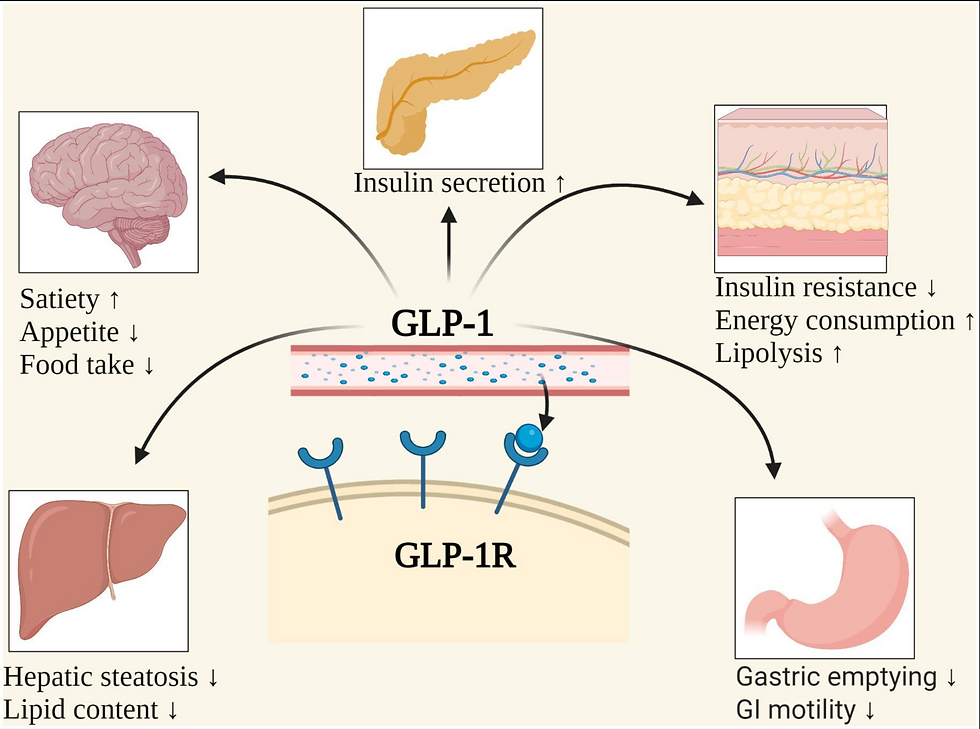
Photo: Receptor Agonists for the Treatment of Obesity (Wang et al.)
What is GLP-1?
Glucagon-Like Peptide-1 is a hormone that the Gastrointestinal Tract – otherwise known as the gut – naturally produces after meals. Specifically, enteroendocrine cells in the small intestine, mainly the ileum and jejunum, release hormones including GLP-1 in response to nutrient exposure.
After meals, GLP-1 attaches to GLP-1 receptors on insulin-producing β-cells – beta cells – in the pancreas. This doesn’t independently force insulin release; instead, it amplifies the pancreas’s existing glucose-sensing machinery in β-cells (special endocrine cells in the pancreas). If blood glucose is detected as high, GLP-1 enhances insulin secretion to the body, which reduces hypoglycemia risk.
The Problem
After GLP-1 is released into the bloodstream, its half-life is ~2 minutes, meaning its concentration drops by 50% every ~2 minutes due to rapid enzymatic breakdown.
This is due to an enzyme called Dipeptidyl Peptidase-4, whose biological role is to terminate signalling of specific peptide hormones, including GLP-1.
At a molecular level, DPP-4 recognizes peptides that have a specific structure, with a proline or alanine in the second position from the N-terminus.
When GLP-1 circulates in the blood, DPP-4 binds to the N-terminal region of GLP-1. DPP-4 completes a dipeptide cut, which destroys the shape required for receptor activation. After this, the truncated GLP-1 fragment cannot bind the GLP-1 receptor effectively. The resulting peptides are biologically inactive, and therefore the insulin-stimulating signalling stops.
Native GLP-1 is active only briefly after secretion; therefore, it cannot maintain sustained insulin moderation across a full day. GLP-1 acts as a rapid post-meal signal, not a long-term regulator.
The Solution
Scientists identified Glucagon-Like Peptide-1 as a key incretin that enhances insulin secretion and slows gastric emptying, but they found that it was unusable as a drug since DPP-4 destroys it within minutes.

Photo: Gila Monster | Description, Habitat, & Facts
Researchers discovered that the Gila Monster, a lizard native to the deserts of the Southwestern United States, housed a naturally occurring peptide – exendin-4 – in its saliva. The peptide is structurally similar to GLP-1 while also being naturally resistant to DPP-4, proving for the first time that a stable GLP-1-like molecule could work therapeutically. This also led to the first drug called Exenatide, which is the synthetic, pharmaceutical version of exendin-4.
However, non-human peptides like exendin-4 have limitations, and one example is an immunogenicity risk. The human body might recognize non-human peptides as foreign and trigger antibody formation, leading to reduced effectiveness or adverse reactions over time. It also might mimic GLP-1, but it’s not identical. Engineered human analogues can be optimized for stronger and more precise receptor activation. And because of this, scientists were able to redesign GLP-1 itself.
They substituted amino acids at the point where DPP-4 would cut, disrupting the enzyme’s ability to recognize and bind to GLP-1. This meant that the molecule would no longer be easily cleaved and would survive much longer. Also, the scientists chemically attached a fatty acid tail to the peptide, allowing the drug to bind to albumin, a large protein in the bloodstream. While bound to albumin, the drug would be protected from breakdown and be too large to be rapidly filtered out by the kidneys. This extended the half-life of the peptide from minutes to ~1 week and further reduced enzymatic degradation. The Name Brands
Many brands have begun to produce and distribute these GLP-1 agonists – drugs that mimic the natural GLP-1 hormone. They’ve been engineered to be far more potent and longer-lasting than what the body makes naturally, and although GLP-1 usually lasts for around a few minutes, drugs like Ozempic can last for a full week. Usually, this is administered through weekly injections with a pen, and a type of oral GLP-1 was approved by the FDA at the end of 2025 and is expected to open a new front of GLP-1 administration.
The two biggest players in the drug industry are Novo Nordisk, a Danish company managing Ozempic and Wegovy (diabetes and obesity), and Eli Lilly, an American company managing Mounjaro and Zepbound (diabetes and obesity).

Photo: Watch Out Novo, Lilly Is Closing the Gap in the Weight-Loss Drug Race (Slabodkin, 2024)
But how does Donald Trump, the President of the United States, have anything to do with this topic? GLP-1 Market Explosion
The GLP-1 market has exploded recently, with many predicting an annual revenue of $58 billion and a massive projection of $132 billion in 2035, obviously showing that the drugs work remarkably well.
However, they were priced out of reach for many people: Ozempic and Wegovy cost $935 and $1349 a month, respectively, and many insurers deliberately exclude GLP-1 drugs for weight loss or impose strict criteria, leading to frequent denials. Medicare has also historically excluded coverage of anti-obesity medications, which has concretely proven that the individuals who would benefit greatly from GLP-1 (those with obesity and type-2 diabetes) are often the most socially and economically disadvantaged – meaning that the people who need the drugs most could least afford them.
Political Intervention: Where Economics Meets Trade Policy
In late 2025 to early 2026, the Trump Administration took the step of tying drug pricing to trade tariffs, which was very unusual since historically drug pricing and tariffs were kept separate. By using a trade weapon to achieve a healthcare outcome, he bypassed Congress, conflated two unrelated domains, and coerced pricing decisions based on the threat of trade penalties. No administration had ever done this before – this was a new model.
Manufacturers like Eli Lilly and Novo Nordisk agreed to lower prices for key drugs, and in return Trump waived tariff taxes for ~three years, and also allowed for smoother access to government-backed distribution channels, and in some cases, preferential positioning.
As a result, Novo Nordisk’s semaglutide agents – Ozempic and Wegovy – will see monthly prices drop from $1,350 (Wegovy) and $1,028 (Ozempic) to ~$200 when purchased through a new
website called TrumpRx, a new government website allowing Americans to purchase directly from pharmaceutical companies at a giant discount.

Photo: TrumpRx. trumprx.gov
The Big Question
Now, with all of this set up, the overarching question is: Who really benefits from the pharma-tariff deal – patients or corporations?
The answer is: both, but not equally, as some may think – the people who need it most are still largely left out.
On one hand, patients are able to benefit from this deal. Before this, federal law had explicitly prohibited Medicare from covering obesity drugs. Since then, this has changed, and some Medicare beneficiaries will have access to GLP-1 medications for weight reduction at a copayment of $50 per month, beginning July 2026, which is especially significant for those on fixed incomes who previously paid $1,000 or simply went without. There has also been a dramatic sticker price reduction, with those buying injectable GLP-1 medications directly from the companies beginning to pay an average of $30 per month, and drugmakers are committed to reducing the price to about $250 over the next 2 years, showing a roughly 75% reduction from list price. Patients will also be introduced to a new oral option with lower pricing, opening the door for people who can’t or won’t use injections.
On the other hand, corporations will also benefit a great deal, and some may argue they will benefit more than the consumers. Firstly, companies that signed the deal with Trump and the U.S. Government received a full exemption from the 100% pharmaceutical tariffs announced on April 2, 2026, so although they might be losing money from cheaper pricing, they are definitely saving money from tariffs. Secondly, when one takes a closer look at the fine print, company price cuts only apply to starter doses, although to be most effective, higher doses are needed, and they remain far more expensive. Also, $350/month is still unaffordable for the most vulnerable. Even after recent price cuts, most states still face double-digit income burdens, with annual out-of-pocket costs exceeding $3,000 per year. And in some cases, states are cutting coverage, not expanding it. California’s Medi-Cal program ended coverage of GLP-1 medications prescribed solely for weight loss starting January 1st, and Pennsylvania followed as well, eliminating Medicaid coverage of GLP-1s for weight loss starting in January, with other states predicted to commit altogether.


Comments